
The Ultimate Guide to the Hazard Perception Test (Pass First Time in 2026)
The Hazard Perception Test is the second part of the Driving Theory Test. You must pass this, as well as the multiple-choice section, to pass your theory test. If you fail either section, you’ll need to retake the whole test (which means more time, more money, and more frustration - so let’s avoid that!)
The Hazard Perception Test, introduced in 2002, assesses your awareness of hazards on the road. You’ll be shown a series of short video clips and must identify hazards as they begin to develop.
With hundreds of thousands of learners failing each year (our FOI request showed that roughly 20% fail), this guide will cover everything you need to know to pass with confidence.

Guide Contents
-
How does the Hazard Perception Test Work?
-
What is a Developing Hazard in the Hazard Perception Test?
-
How do you score points in the Hazard Perception Test?
-
What is the pass mark for the Hazard Perception Test?
-
Why do people fail the Hazard Perception Test?
-
How to prepare for the Hazard Perception Test
-
Hazard Perception Frequently Asked Questions.

Bitesized Driving Theory & Hazard Perception Video Course
Struggling with the Theory Test & Hazard Perception, or failed before? Our video course is designed to guide you step by step through everything you need to know to pass, with over 5 hours of clear, easy-to-follow video lessons. The course includes over 700 DVSA revision questions, 10 complete walkthroughs of hazard perception clips, downloadable revision guides, and a proven structure that can be completed in as little as 7 days. Best of all, it costs less than a single driving lesson!
LEARN MOREHow the Hazard Perception Test Works
The Hazard Perception Test comes after the multiple-choice section.
You’ll have a short break, followed by an instructional video explaining how the test works. You’ll wear headphones for this part as the video has a voiceover.
You’ll then watch 14 Hazard Perception video clips on a computer. These clips:
- Have no sound
- Last around 1 minute each
- Show real driving scenarios from the driver’s perspective
- Include different environments (towns, cities, country roads, day and night)
The full test takes around 20 minutes.
What is a Developing Hazard?
To pass the Hazard Perception Test, it’s essential to understand what you’re actually being marked on… This is where most people go wrong!
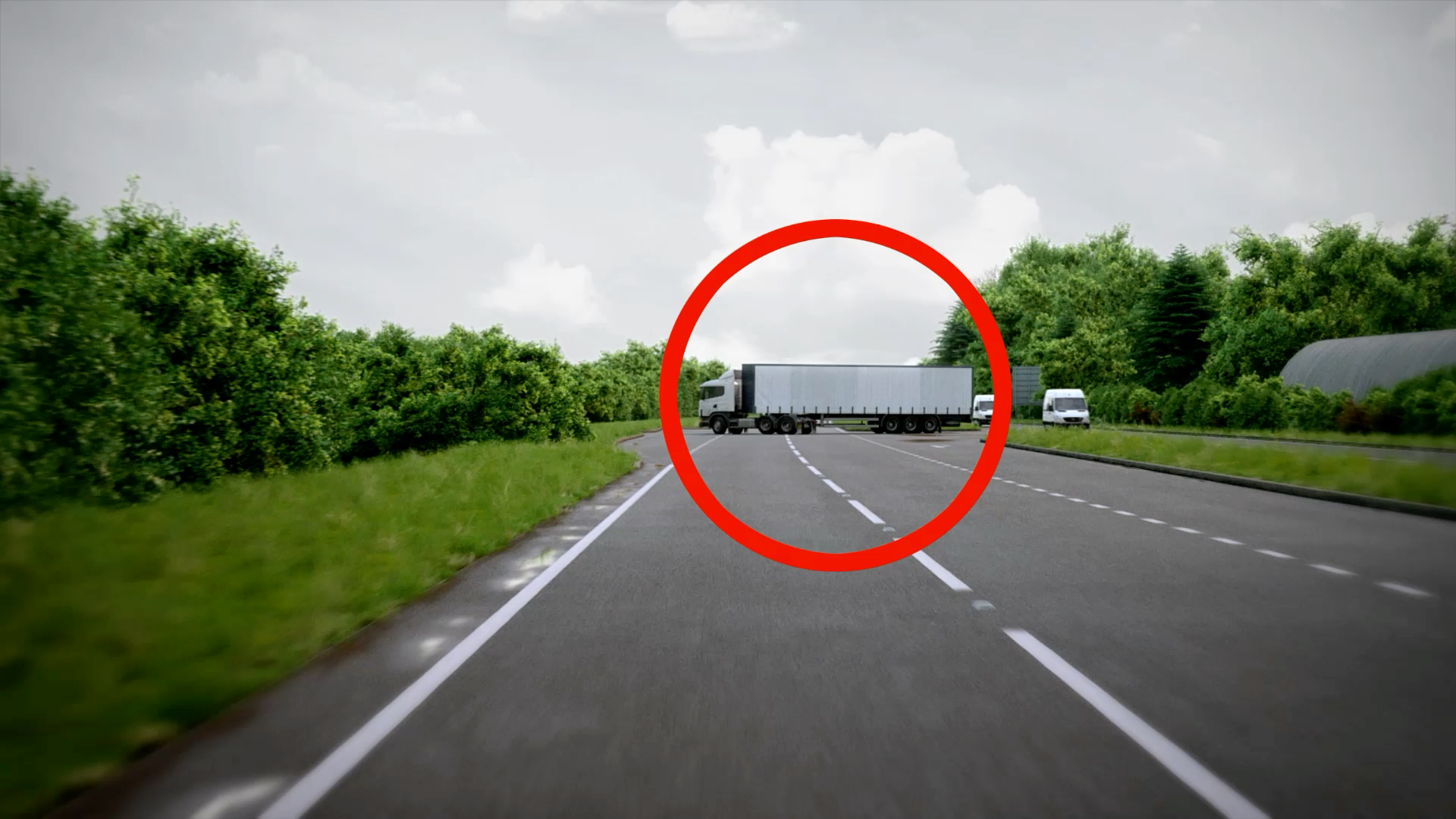
You are scored on your ability to spot developing hazards. A hazard is anything that could cause you to change speed or direction. Hazards fall into two types:
- Static hazards – These don’t move (e.g. bends, junctions, narrow roads). These are not assessed (so don’t waste clicks on them).
- Moving hazards – These involve other road users (e.g. cars, cyclists, pedestrians). These are assessed.
A developing hazard is a moving hazard that is starting to require action from you. Example: If you’re approaching a junction, that’s a static hazard (no points for spotting that). But if a car is approaching the junction and looks like it might pull out, that’s a developing hazard.
How the Scoring Works
You score points by clicking when you see a developing hazard.
Here’s how it works:
- Each clip has 1 developing hazard (one clip has 2, just to keep you on your toes).
- A flag appears at the bottom of the screen when your click is registered.
- You cannot change your answer after the clip ends; you get one attempt at each.
- Each hazard is worth up to 5 points.
- You don’t lose marks for incorrect clicks (so don’t be afraid to click, just don’t go wild!)
Scoring System
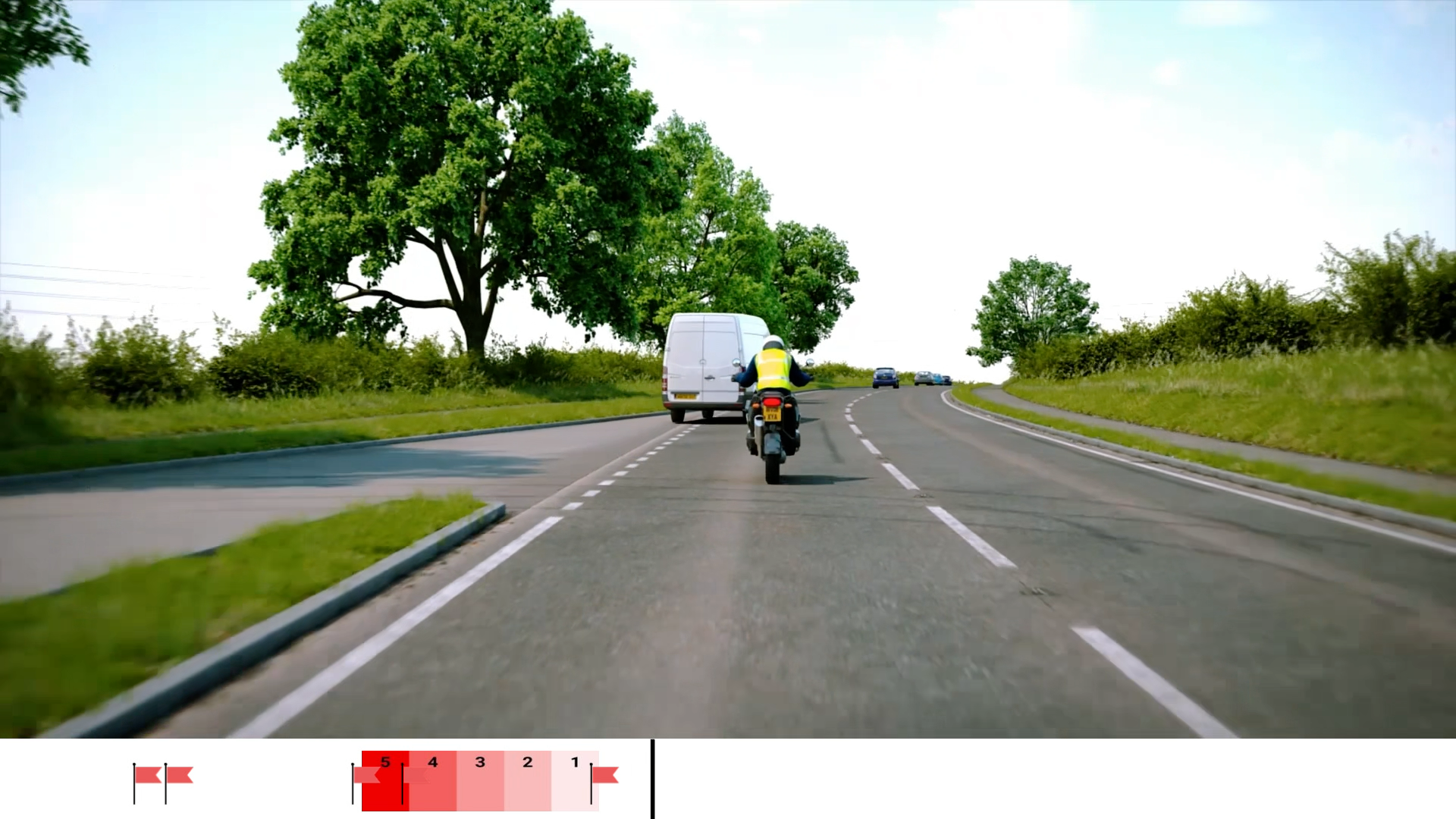
Each hazard has a time window, split into 5 scoring zones. If you spot the hazard as soon as it appears, you’ll score 5 points. A little later…. 4 points. A little later… 3 points, and so on…
Think of it like this: The earlier you react (like a good driver would), the higher you score.
Pass Mark
- Maximum score: 75
- Pass mark: 44
That means you need an average of around 3 points per hazard.
So the good news is that you can still pass even if you mess up a few clips. So if one goes badly, don’t panic, the test isn’t over!
Common Mistakes That Make People Fail
Our FOI request to the DVSA showed that over 400,000 people failed the Hazard Perception Test last year.
Most failures come down to the following three simple mistakes (all easily avoidable):
1. Clicking Too Early
Yes, this is actually a thing and a common frustration learners face when taking the test. Some learners are so switched on that they click before the scoring window even starts, which scores zero.
To avoid this, use the 3-click method:
- Click when you first spot the hazard
- Click again about a second later
- Click a third time as it develops
2. Clicking Too Late
On the flip side, waiting too long means you miss out on points. Don’t wait for the hazard to fully happen (e.g. a car pulling out dramatically in front of you). Click when it starts to develop (e.g. as the car approaches the junction at speed)
3. Clicking Too Many Times
This is where people panic-click. The system is designed to spot: Repeated clicking Clicking in patterns If you do this, you could score zero for the entire clip (not ideal).
How to prepare for the Hazard Perception Test
Now you know how the Hazard Perception Test works, you may be thinking, what’s the best way to put what you’ve learned to the test and practice?
Our Driving Theory Video Course will teach you everything you need to know to pass both sections of the test with confidence. We cover exactly how the Hazard Perception Test works and provide walkthrough examples so you can see the theory put into practice. You can then practice with dozens of example clips.
If you struggle with reading books or find apps unhelpful, our course uses short, engaging video lessons to explain every topic clearly. Each lesson includes quizzes, using over 700 DVSA-style revision questions, so you can test your understanding as you go.

Bitesized Driving Theory & Hazard Perception Video Course
Our video course is designed to guide you step by step through everything you need to know to pass, with over 5 hours of clear, easy-to-follow video lessons. The course includes over 700 DVSA revision questions, 10 complete walkthroughs of hazard perception clips, downloadable revision guides, and a proven structure that can be completed in as little as 7 days. Best of all, it costs less than a single driving lesson!
GET STARTED